AI is the New Balloon Guy
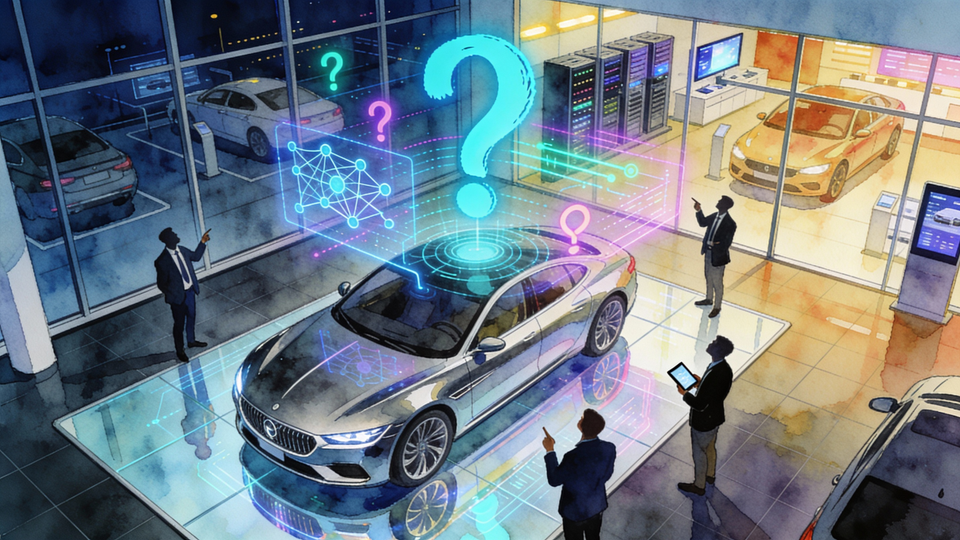
NADA is coming, and the helium is free. Just don't expect a handful of strings to float a sinking P&L.
The thought didn’t arrive during a glossy demo or a vendor webinar. It showed up while looking at the calendar for the NADA Show. Another year of immaculate booths and software designed by people who have never reconciled a month-end statement.
The future, as always, looks expensive.
That’s when I thought about the balloon guy.
There’s a moment at every dealership event, grand opening, anniversary sale, or factory-mandated celebration when a man appears with a tank of helium and the calm certainty of someone who understands exactly where he fits in the ecosystem. He ties balloons to mirrors, antennas, railings, anything that will tolerate string. Bright colors. Gentle upward motion. Optimism hovering a few feet above the asphalt, where it can’t be crushed by reality.
Nobody truly believes balloons sell cars. They sell activity. They signal that something is happening here, that the lights are on, that the place is alive and worth slowing down for.
Nobody truly believes balloons sell cars. They sell activity. They signal that something is happening here, that the lights are on, that the place is alive and worth slowing down for. It isn’t deception so much as atmosphere, the retail equivalent of a busy restaurant window that makes you assume the food must be good.
That’s increasingly the role AI is playing in dealer software.
AI didn’t arrive like a revolution. It drifted in quietly, bundled into updates, folded into dashboards, appended to features with soft verbs designed to avoid resistance. Assisted. Enhanced. Powered by. Over time it stopped being something you evaluated and became something you assumed, like balloons on a Saturday.
That’s the blind spot. Dealers are practiced at reading signals–it’s what makes them good at retail. It’s also what makes this one effective.
Retail auto runs on cues. Window stickers, showroom lighting, certification language, event weekends. None of this is dishonest. It reduces friction. It helps customers move forward without requiring a lecture on modern commerce. AI is now being used the same way in software, less for what it demonstrably does than for what it implies: modernity, competence, future readiness, the reassurance that you’re not falling behind.
AI is now being used the same way in software, less for what it demonstrably does than for what it implies: modernity, competence, future readiness, the reassurance that you’re not falling behind.
The problem isn’t the implication itself. It’s that implication is now being priced and sold as infrastructure.
This is where the undercoating comparison matters. Undercoating wasn’t fake. It worked, once, under specific conditions, on specific cars, in specific climates. Over time it became something else, a habitual add-on justified by margin long after its necessity had faded. AI is drifting into that same territory: decoration sold as infrastructure.
There’s a simple way to test the difference.
If you turned it off tomorrow, what would actually break?
If the answer is unclear, philosophical, or emotional, then whatever you’re paying for isn’t infrastructure. It’s decoration.
That distinction matters because AI doesn’t stay decorative for long. It touches data, and data touches liability, trust, and reputation. The consequences aren’t usually explosive. They’re quiet. Customer data leaks into logs accessible to third parties. Candid service notes, the kind that keep a store running, surface in AI summaries never meant to leave the building. Sales calls are ingested to “improve the product,” a phrase that usually means improving the vendor’s model at the dealer’s expense.
No one sets out to be reckless. They just stop insisting on clarity. By the time you ask where the data went, it’s already gone.
This isn’t an indictment of AI. It’s an indictment of sloppy thinking.
This isn’t an indictment of AI. It’s an indictment of sloppy thinking.
Real AI value in a dealership doesn’t announce itself. It shortens response times. It routes leads correctly at scale. It cleans data before humans touch it. It reduces errors quietly and consistently, without demanding a banner on the homepage. When it’s done right, it feels less like innovation and more like process, the kind you only notice when it’s missing.
Dealers aren’t anti-technology. Anyone who claims otherwise has never watched a store adopt new tools under pressure. Dealers adopt technology quickly because they operate in real time, with real competition across the street and real margin pressure behind the scenes. What they resist isn’t progress, it’s paying for things that don’t pull their weight, especially when the risk accumulates on their side while the upside stays with the vendor.
As the NADA show floor lights up again, there will be no shortage of booths with AI on the banner and confidence in the delivery. That’s expected, that’s commerce. The smartest operators won’t be impressed by helium, they’ll be listening for substance: clear data boundaries, explicit permissions, plain-English ownership of outputs, and accountability that doesn’t disappear the moment something goes wrong.
Balloons come down at closing time. Not because they failed, but because their job was temporary. AI in dealer software deserves the same discipline. If it’s core, it should prove it. If it’s helpful, it should earn its keep. And if it’s decorative, that’s fine, as long as nobody pretends it’s structural.
Eventually someone will ask why the lot is full of helium and the numbers still aren’t lighter.
Paul Salzman views the technology and automotive industries with curiosity, skepticism, and the hard-earned instinct to question the headlines. Learn more at paulsalzman.com
Originally published on LinkedIn.

Comments ()