Grumble and Renew: The Hidden Economics Destroying Margins
Wheelio Dealer Sentiment Report · May 2026
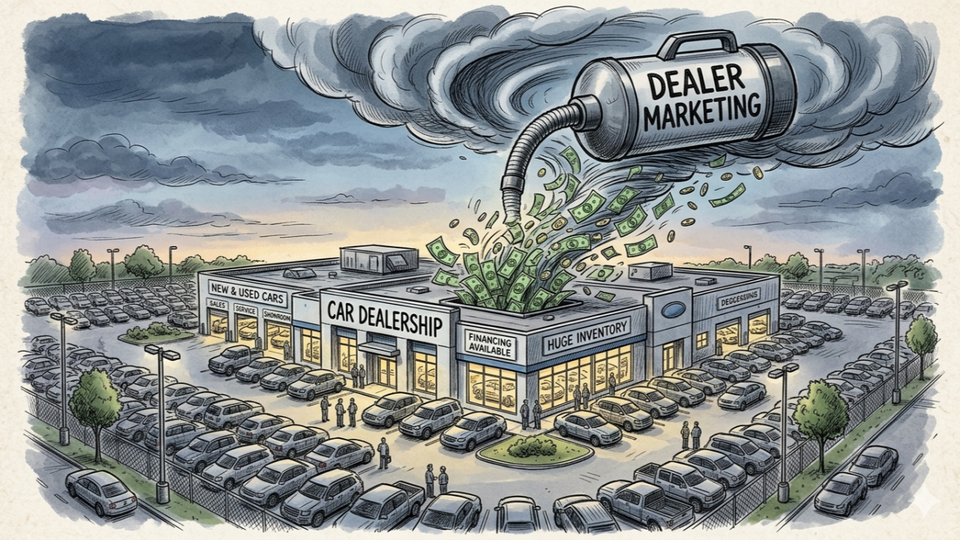
American auto dealers spend over $14 billion a year on platforms they openly resent. This is the story of why they keep paying, what it is actually costing them, and what the 2026 regulatory landscape just changed forever.
There is a phrase you hear if you spend enough time in automotive retail forums and dealer 20 Groups. It surfaces in conversations about CarGurus, AutoTrader, and Cars.com, almost word for word, from dealers in different states, different sizes, different markets.
"I hate paying them. But if I turn it off, my phone slows down."
That sentence is the entire story of third-party automotive listing platforms, compressed into 16 words. It explains why a deeply frustrated industry keeps renewing contracts it resents, and why a $14 billion market built on that resentment has remained largely intact for two decades.
We spent several months compiling dealer sentiment research, sourcing published industry data, and mapping the economic and regulatory forces reshaping automotive retail in 2026. What follows is a summary of what we found.
TWO BILLS. ONLY ONE SHOWS UP IN THE BUDGET.
NADA data puts average dealer advertising spend at $739 per vehicle retailed, totaling $9.96 billion annually across the industry. Of that, Ritner Digital benchmarks show an average of $109,487 per rooftop per year flowing directly to third-party listing platforms — the single largest digital line item most dealers carry.
That is the visible bill. There is a second one that never appears as a line item, because it is paid in wasted labor, dead leads, and missed sales. Industry estimates put the operational friction cost at an additional $300 to $700 per vehicle sold, driven by fragmented software tools, response time failures, and lead handling breakdowns.
Added together, the true structural cost to retail a single automobile runs between $1,039 and $1,439 per unit. That is the number dealers almost never calculate, and the one that matters most to their margin.
IT IS NOT A MARKETING TOOL. IT IS A TOLL ROAD.
Base subscriptions provide negligible visibility. To appear on page one of local search results, dealers must purchase premium placement tiers, sponsored badges, and pay-to-rank enhancements — pushing real monthly costs to $3,000 to $10,000 per rooftop. Reduce the spend, and inventory falls to page four. The rate goes up every year just to maintain the same position.
When a consumer clicks on a dealer's listing, the platform places competitor vehicles from rival dealers directly on the same page. The dealer pays for the digital real estate. Competitors benefit from it.
And when a buyer submits an inquiry, the platform intercepts their real contact information and replaces it with a proxy address that expires within 30 days. Every customer must be re-purchased, at full price, from the same platform, indefinitely.
"We cancelled CarGurus after a 30 percent price increase. We actually sold more vehicles after we cancelled." — DealerRefresh community forum, 2025
WHEN THE DIGITAL EXPERIENCE WORKS PERFECTLY, SATISFACTION HITS ZERO.
The CDK Global 2026 Friction Points Study, released January 2026, surfaced a finding that should alarm everyone in automotive retail. Shoppers who completed their entire car purchase digitally reported a Net Promoter Score of exactly zero. Traditional hybrid shoppers scored plus 29.
The reason: the website calculator and the finance desk operate on completely disconnected systems. A buyer calculates $420 a month online, drives to the dealership expecting to sign, and discovers the actual quote is $465. The $45 gap is not dishonesty. It is a data infrastructure failure. The buyer experiences it as a betrayal.
The same study found that 58% of all car shoppers encountered a direct, identifiable problem during their dealership interaction in 2026 — primarily tied to wait times, communication failures, and pricing transparency. That number has not improved in years.
THE RULES JUST CHANGED. THE PLATFORMS WERE NOT BUILT FOR THEM.
The FTC's formal CARS Rule was withdrawn in February 2026. Dealers exhaled. Then on March 13, 2026, the FTC sent Penalty Offense Notices to 97 of the nation's largest dealer groups, warning that advertising any vehicle price excluding mandatory fees is an immediate federal violation — with civil penalties up to $53,088 per individual infraction.
In California, Senate Bill 766 takes effect October 1, 2026. It requires that a dealership's first written digital communication referencing a specific vehicle must include a complete, itemized total price. If a buyer texts "is the white truck still available?" and a rep texts back "yes, want to come in?" without embedding the full price disclosure, that is a statutory violation. Every compliant communication must be retained for two years.
Because California represents roughly 12% of U.S. auto sales, this effectively becomes a national standard. The fragmented, five-app communication infrastructure most dealers operate today was not built for this compliance environment.
GRUMBLE. RENEW. WHY THE SWITCH IS HARDER THAN THE FRUSTRATION.
The most important finding in our research is also the least comfortable one. Dealer frustration does not automatically produce switching behavior. The industry has been loudly dissatisfied with listing platforms for the better part of a decade. Prices keep rising. Dealers keep paying.
The reason is rational. Turning off a major platform means turning off traffic. Brett Sutherlin of Sutherlin Automotive pulled his four-store group off all major third-party platforms in 2023 after calculating true lead costs as high as $2,000 per unit. He is not the norm. He is what the norm becomes when a dealer can see a working alternative before making a blind leap.
The emotional case against the incumbents is already made. It has been made for years. What is missing is not more frustration. It is proof.
Read the full report: The Dealer Reckoning — May 2026
Nine sections. Named sources. An honest breakdown of what is verified, what is estimated, and what the 2026 regulatory environment means for every dealer running a fragmented communication stack.
Sources: NADA Annual Dealer Data / CDK Global 2026 Friction Points Study (January 2026) / Ritner Digital Benchmark Reports / FTC Enforcement Actions March 13, 2026, via Nelson Mullins Law / California SB 766, analysis by ComplyAuto / Brett Sutherlin, Sutherlin Automotive, Car Dealership Guy Newsletter January 2025. Operational friction estimates ($300–$700/vehicle) reflect broad industry consensus, not a single primary study.
Originally published on LinkedIn.

Comments ()