Squirrel Torque
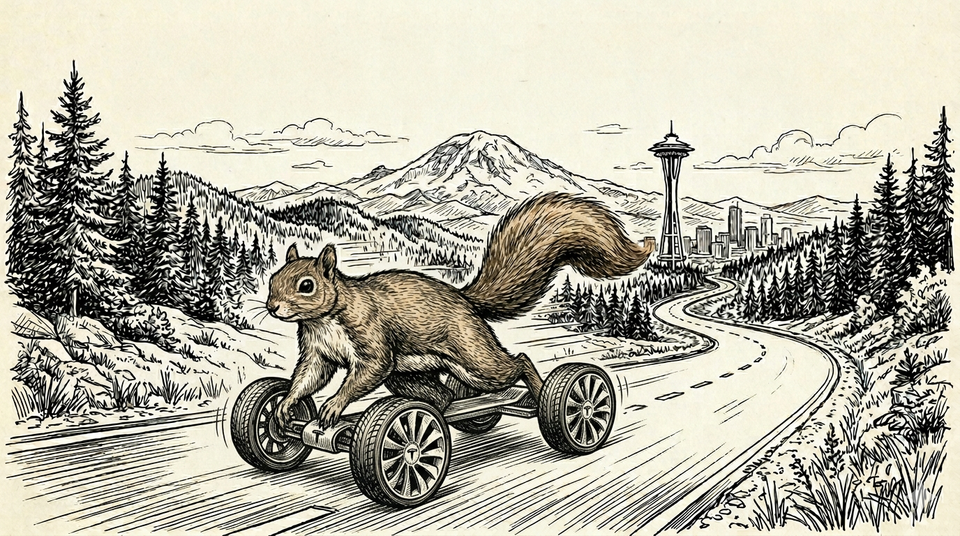
by Paul Salzman
Watch a squirrel long enough to see the full sequence, and you'll notice that the animal operates on exactly two settings: total stillness and absolute commitment. It reads something invisible to you, something in the air or the grass or the geometry of the nearest tree, and then it moves, and the decision and the movement are the same moment. There is no hesitation visible from the outside. There is no turn signal. One moment the squirrel is there; the next moment it is somewhere else entirely, and whatever was between those two states happened faster than you could register it as intention.
There is a car on American roads that drives exactly like this.
Tesla, as a brand, has dropped some of the quickest automobiles ever made into the hands of drivers who have never been to a track day and have no particular plans to attend one. Quick, mind you, is a different thing from fast. Fast is what a car does through a corner, in conversation with the road, carrying speed across distance with some mechanical honesty about what's happening beneath the tires. Quick is what happens in the first three seconds. Tesla has cracked quick with almost comic generosity. The Model Y Performance reaches sixty miles per hour in 3.3 seconds. The Model 3 Performance does it in under three. A BMW M3 Competition, which is what a person buys when they want their driving enthusiasm taken seriously, does it in 3.2. A Ferrari 360 Modena, the mid-engine Italian supercar that represented the outer edge of accessible performance at the turn of the millennium, needed 4.3. The Tesla, which has a frunk and over-the-air software updates and a fifteen-inch touchscreen where the instrument cluster used to be, is quicker than both. The instant torque of an electric motor means there is no hesitation between intent and execution, no gear to find, no turbo to spool, no mechanical storytelling between your foot and the road. You press, it goes. The squirrel doesn't telegraph either.
The instant torque of an electric motor means there is no hesitation between intent and execution, no gear to find, no turbo to spool, no mechanical storytelling between your foot and the road. You press, it goes. The squirrel doesn't telegraph either.
So far so good. The car is honest about what it is. The problem is everything that happens around the honesty.
One-pedal driving, which is how most Tesla owners operate most of the time, means that lifting your foot off the accelerator produces significant deceleration through regenerative braking, and it does so with brake lights that illuminate on a threshold-based delay the driver behind you has no reason to know exists and federal safety standards never actually required.
Then there is Autopilot, and specifically what Autopilot does in town, which is where the squirrel metaphor earns its keep. The system is confident and capable on highways, where the variables are relatively bounded. In town, the variables are not bounded. A construction cone in an unexpected position, a pedestrian crossing at an odd angle, an intersection that doesn't conform to the training data in whatever way matters at that particular moment, and the system makes a decision, which is to stop making decisions. One chime. The wheel is yours. Owners report the car sitting contentedly in the wrong lane entirely, then making a last-minute dart across traffic to position itself correctly, a maneuver that looks, from outside the vehicle, like the driver suddenly remembered where they were going. The squirrel freezes at the curb, reads its invisible data, then commits so fast it's already gone before you process the movement. What happens in between is entirely your problem.
The wheel is yours. Owners report the car sitting contentedly in the wrong lane entirely, then making a last-minute dart across traffic to position itself correctly, a maneuver that looks, from outside the vehicle, like the driver suddenly remembered where they were going.
The drivers have absorbed the car's personality, or possibly developed their own version of it, and the result is something the internet has been cataloguing with the diligence of field researchers who really needed something to be angry about. West Coast observers are consistent in their notes: Tesla drivers cruise ten to fifteen miles per hour below the posted limit, maintain following distances that suggest they are hauling nitroglycerin, and then, the moment someone attempts to merge in front of them, find the accelerator with sudden and total conviction. Frozen, then explosive. The squirrel's two modes, available in Long Range AWD for fifty thousand dollars.
Seattle deserves its own paragraph, if only because it functions as a natural laboratory for this particular pathology. The Pacific Northwest has elevated slow driving from habit to civic virtue, the kind of place where four cars will occupy the passing lane at forty-five miles per hour in a loose formation that is less traffic and more statement, a rolling declaration that nobody here is in that much of a hurry and you shouldn't be either. Put that culture inside a vehicle with instant torque, a one-pedal learning curve, and a system that will occasionally and without ceremony simply hand the controls back to whoever is sitting closest to the wheel, and what you have is something that stopped being a commute some time ago. It is a philosophical negotiation with a machine, conducted by someone who came in underprepared.
The insurance industry has drawn its own conclusions. A 2025 LendingTree study found nearly thirty-seven incidents per one thousand Tesla drivers across accidents, citations, and DUIs, the highest rate of any brand on the road. The inconsistency is the problem, not the speed. The actuaries noticed. Tesla now ranks twenty-second out of twenty-three vehicle brands in insurance affordability. Full coverage on a Model Y costs nearly four thousand dollars annually, up twenty-nine percent in a single year, rising at nearly three times the national average rate of increase. The Model Y led every vehicle on the road in insurance claims frequency in 2024. The Model 3 finished second. The two most popular Teslas, the ones most likely to be driven by people who bought the car for the technology and the efficiency and the frunk and the app, are also the two cars most likely to generate a claim. The squirrel, for all its apparent chaos, has never filed one.
...the two cars most likely to generate a claim. The squirrel, for all its apparent chaos, has never filed one.
What Tesla actually built, beneath the software and the skateboard chassis and the quarterly delivery numbers, is a personality test with a charging port. The car is decisive. The machine has no ambivalence about what it is or what it can do. The confusion belongs entirely to the humans operating it, and it tends to express itself in one of two ways. There is the driver who hands the decision to the software and is then surprised, somewhere on a surface street in Bellevue or Burlingame, when the software hands it back. And there is the driver who never fully commits to the machine at all, who bought three seconds to sixty and is using maybe half of one of them, who keeps it in Chill Mode the way someone buys a boat and never leaves the marina. Both are forms of the same problem, which is a mismatch between the capability of the machine and the fluency of the person inside it.
Tesla will fix the software. That is, more or less, what they do. Every complaint in this article about Autopilot freezing at a construction cone or making a last-minute lane change like a driver who just remembered their exit is already being processed by a neural network somewhere in Palo Alto, absorbed into the fleet's collective experience, and scheduled for remediation in an update that will arrive silently overnight while the car sits in your garage. The machine learns. That is the whole project. In five years, or ten, the specific behavioral quirks described here will read the way early complaints about GPS read now, as charming period detail from a time when the technology was still deciding what it wanted to be when it grew up.
The drivers, however, are not receiving over-the-air updates. There is no patch for the person who bought a Ferrari-beating crossover and immediately enrolled it in Chill Mode because the throttle response during the test drive made them grip the door handle. There is no firmware for the driver who spent two years allowing the car to make the decisions and has now, with the wheel unexpectedly back in their hands at a tricky intersection, arrived at a philosophical reckoning about what driving actually requires of them. Tesla's fleet accumulates millions of miles of training data every single day. The average Tesla driver accumulates the same commute, at the same pace, with the same fifteen-car following distance, and files it under experience. The software will outgrow this article. The question of what to do about the people piloting it is, as they say in Silicon Valley, a harder problem.
The question of what to do about the people piloting it is, as they say in Silicon Valley, a harder problem.
The squirrel has no such division. It did not acquire the ability to move at that speed and then quietly wonder whether perhaps it was a bit much. Thirty-five million years of iteration produced one outcome: an animal that is exactly as committed to its capabilities as its capabilities require. It freezes, it reads, it goes. There is no Chill Mode. There is no chime. There is no version of the squirrel that bought all that acceleration and decided to use it mostly for errands.
It has also never, in the entirety of its evolutionary history, needed insurance.
Paul Salzman has spent his career at the intersection of automotive, technology, and consumer behavior, which is a polite way of saying he has seen every bad idea tried twice and funded a third time. He writes editorial commentary on an industry that confuses installing software with having a strategy. He is the founder of Wheelio, which sits at the intersection of search and connection; obliterating the friction between buyer and seller.

Comments ()