The Architect of Perceptional Momentum
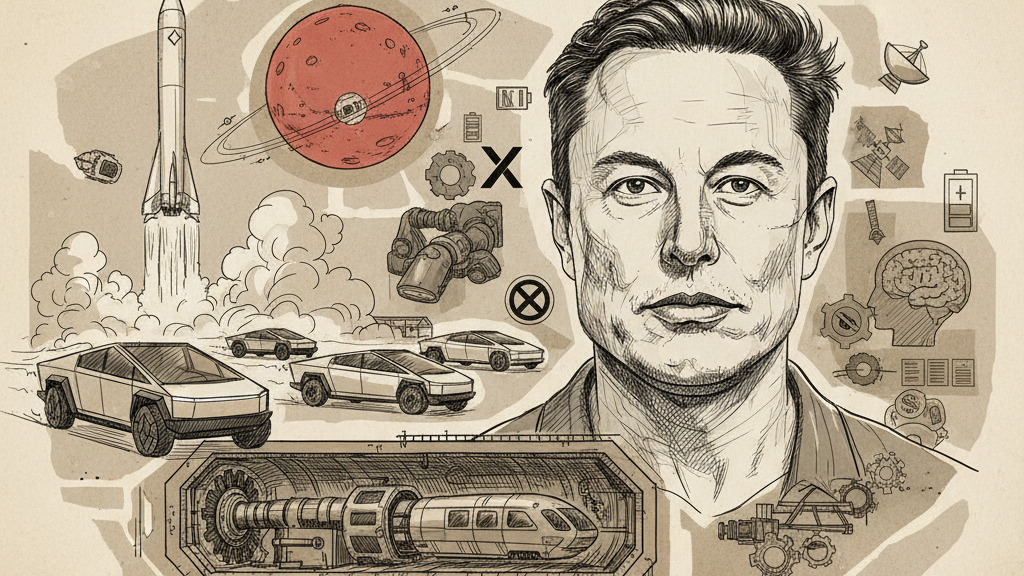
Elon Musk’s Greatest Invention Isn’t a Car or a Rocket—It’s the Machine That Makes Us Believe
Some men build machines.
Elon Musk builds momentum.
The curtain rises, the lights flare, and there he is—part Tony Stark, part ringmaster—standing between two chrome-limbed robots that look like they escaped a Daft Punk tribute act. They twitch, they wobble, the crowd goes wild. Musk grins like a man who’s just rewritten physics.
“I think it’s going to be the biggest product of all time,” he says, promising that humanoid robots will soon roll off Tesla’s lines by the million. He talks of multiplying the global economy by a factor of ten, maybe a hundred. It’s pure science fiction, but that’s the point.
He’s not just selling machines. He’s selling the future itself, wholesale and with a lifetime warranty on optimism.
The Dream Machine
Tesla’s true genius isn’t in lithium or line speed. It’s in narrative control. Musk figured out that in the attention economy, belief compounds faster than interest.
Every announcement resets the clock:
Full Self-Driving “next year.”A $25,000 Tesla for the masses.A million robotaxis on the road by 2020.Mars by Tuesday, give or take.
Full Self-Driving “next year.”
A $25,000 Tesla for the masses.
A million robotaxis on the road by 2020.
Mars by Tuesday, give or take.
Each promise acts like a starter motor for the next one. When reality lags, he revs louder. Investors don’t mark down the miss; they double down on the dream.
Meanwhile, the trail of un-kept deadlines grows longer than a Vegas valet line. The $35,000 Model 3 that flickered in and out of existence; the Cybertruck, four years late and still wearing a “pardon our recall” sign; the Semi, somewhere between prototype and rumor; the Roadster that’s been accepting quarter-million-dollar deposits longer than some marriages last.
Even the Hyperloop, once touted as a vacuum-tube bullet train, now exists as a tunnel under Las Vegas where ordinary Teslas, piloted by human drivers, ferry conventioneers between halls at 35 mph. No vacuum, no mag-lev—just a guy in a polo shirt steering through a neon drainpipe.
If Elon Musk can’t make autonomy work in a sealed tunnel with no traffic, what hope does he have on I-405 at rush hour?
That single image says more than a dozen press releases.
How the Trick Works
The pattern is almost elegant.
Proclaim the impossible. Collect deposits and headlines. Miss the deadline, change the subject.
Proclaim the impossible.
Collect deposits and headlines.
Miss the deadline, change the subject.
By the time anyone asks what happened to the last miracle, a new one is already glowing onstage.
When a Delaware court shredded his $56 billion pay package, Musk didn’t retreat; he reincorporated in Texas and returned with a new deal worth up to a trillion dollars, tied to future milestones so outlandish they make Star Trek look like documentary. The shareholders cheered anyway.
Because Musk has learned something fundamental about modern markets: accountability is optional if your imagination is fast enough.
The Gospel According to Optimus
At that shareholder meeting, he unveiled his latest dream-birth... Optimus, the robot that will supposedly do for manual labor what the Model S did to propel the world into our EV future.
Production, he says, will begin next year; one million units in Fremont, ten million in Austin, “maybe a hundred million, maybe a billion someday.”
Reality check. Boston Dynamics, the company that actually sells walking robots, moves about four hundred units a year at roughly $75 thousand each. They open doors, climb stairs, and don’t need a puppeteer. Tesla’s bots? Still tele-operated during demos.
Yet that doesn’t slow the applause. Because when Musk talks about robots, he isn’t describing a business plan, he’s renewing the faith.
The Physics of Faith
Faith needs fuel.
Pre-orders, deposits, and valuations provide it. Each new product becomes an interest-free loan from believers. The second-generation Tesla Roadster alone has parked untold millions in Tesla’s accounts without a single car delivered. It’s capitalism’s version of crowd-funding, except this crowd wears Rolexes.
And Musk, unlike any CEO before him, knows how to convert conviction into currency. SpaceX lands its rockets on barges like returning heroes. That success gives him credibility to chase ever wilder frontiers. When one venture stalls, another lands, and the halo transfers instantly.
It’s not deception, it’s choreography.
The Cult of the Next Thing
Musk has weaponized our national allergy to boredom. The man could sell a timeshare on Mars and find buyers before breakfast.
He’s an industrialist in the old sense—half engineer, half evangelist—but with a modern twist: he doesn’t need to finish a product before selling the sequel. That’s why he gets away with it. Each half-done promise dangles just long enough to keep us watching.
Critics call it hype. Admirers call it vision. Either way, the stock market calls it profit.
The Moment of Truth (Maybe)
The risk in all this is subtle. If Musk ever does slow down long enough for reality to catch up, he’ll have to deliver on the ledger, not the legend. Investors who paid for prophecy might ask for proof.
Maybe the robots will march off the line, maybe not. Maybe we’ll ride to work in driverless Teslas that actually drive themselves. Even if none of that happens, Musk has already changed the game. He proved that in modern capitalism, imagination has a market cap.
The Last Word
Elon Musk isn’t a fraud. He’s an optimist with a balance sheet.
He builds real machines—rockets that land, cars that outsell Toyota's—and he builds illusions that make those machines worth ten times more than they should be.
That’s his genius and his gamble: a perpetual-motion narrative powered by our hunger to believe that tomorrow can be pre-ordered today.
And until someone invents skepticism as contagious as his confidence, the engine will keep spinning.
Because Musk doesn’t just sell us cars or rockets or robots. He sells us on him, and we keep buying the ride.
Paul Salzman views the technology and automotive industries with curiosity, skepticism, and the hard-earned instinct to question the headlines.
Originally published on LinkedIn.
Comments ()