The Ethos That Would Not Bend
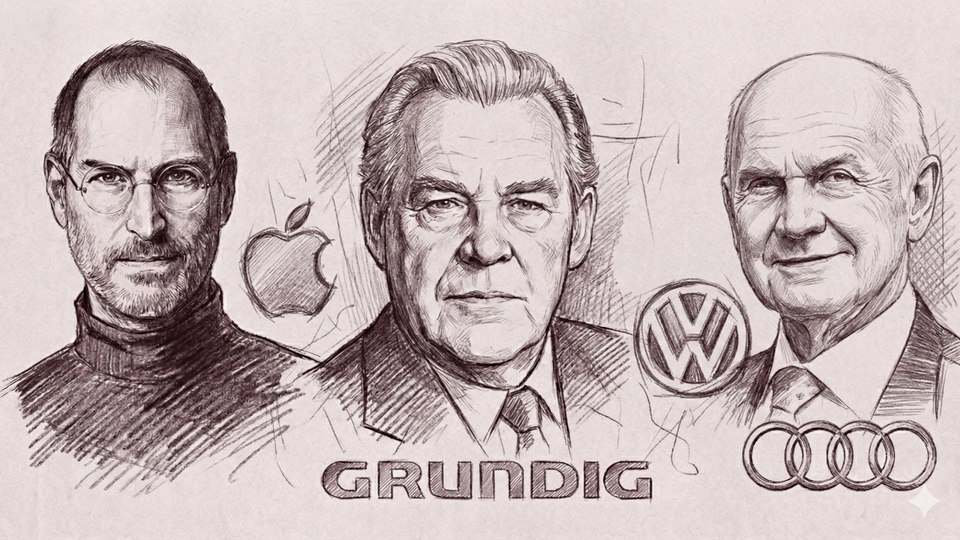
Steve Jobs, Max Grundig, and Ferdinand Piëch – three men who treated design and engineering as moral obligations rather than corporate tasks.
There is a rare breed of leader who does not simply run a company but imprints himself onto every bolt, seam, solder joint, and circuit trace. These are the people who believe products carry moral weight, that a machine can tell the truth if its maker demands it. They have no interest in perfectionism. Perfectionism is for neat freaks and catalogers. These men pursue something harder and far less fashionable: integrity.
Integrity is the belief that a product should be right, internally and invisibly, even when few will ever know the difference.
Steve Jobs, Max Grundig, and Ferdinand Piëch lived that conviction so completely that it reshaped entire industries. They worked in different nations, under different pressures, and built entirely different machines, yet they shared one trait. They led with engineering ethics, not corporate ones.
When they left their companies, the culture did not politely weaken. It sagged like a roof beam that had lost its load-bearing post.
This is their story.
And it is the philosophical inheritance I am choosing for my next act.
The Fence, the Father, and the Unseen Truth
People often forget how early Steve Jobs learned the morality of design. They imagine it emerging with the iMac, NeXT, or some mystical epiphany. It actually began in a garage with a brush, a can of paint, and a wooden fence.
His father, Paul Jobs, was a mechanic and craftsman, the kind of blue-collar perfectionist America used to produce without irony. He handed young Steve a paintbrush and said, “Paint the back of the fence.”
“No one will ever see it,” Steve argued.
Paul Jobs did not soften, “But you will know it’s there.”
That sentence became the spark that ignited Apple’s philosophy. Steve Jobs did not worship beauty. He worshiped honor – the duty of a thing to be correct even in the places no customer would ever look.
Then he met Steve Wozniak, an electronics wizard who saw code as poetry. Woz’s circuit boards were laid out like miniature architectural blueprints. He designed with elegance for its own sake. The Apple I was not a consumer device. It was an expression of engineering conscience.
Jobs recognized the ethic instantly. That unseen discipline became the foundation of the company he intended to build. Apple would make “bicycles for the mind,” but only because the internal work was worthy of the metaphor.
Apple succeeded not because it made beautiful objects.
It succeeded because it made true ones.
Then Apple pushed Jobs out in 1985, and the truth leaked out with him. The company drifted into mediocrity. Its computers became generic. Its design timid. Its product roadmap looked like bureaucratic improv.
When Jobs returned in 1997, Apple was months from bankruptcy. He did not give a speech or host a brainstorming session. He pruned. He cut the product line to the bone and reinstated Paul Jobs’s law: if the inside is not right, the outside is a lie. He instilled the philosophy into Jony Ive who led design.
Everything good Apple ever made followed that principle. The Apple II, the iMac, the iPod, the iPhone, and the iPad were all built on the same foundation.
Not magic. Integrity.
Max Grundig: Rebuilding a Nation One Radio at a Time
Cross the ocean, rewind fifty years, and step into Germany in 1945. The country is flattened. The economy is shattered. The Allies forbid radio manufacturing because vacuum tubes and certain coils are restricted to essential industries. Anything capable of receiving a broadcast is effectively illegal to manufacture. There is no market, no capital, and no supply chain.
For most manufacturers, that was the end of the conversation.
For Max Grundig, it was the beginning.
Working out of his mother’s house in Fürth, now a protected landmark, he created the Heinzelmann. It was not a finished radio and not quite a Heathkit-style hobby kit. It was a partially assembled chassis, neatly wired and mostly complete, sold as a “toy construction set,” a phrase that must have made Allied regulators blink.
Grundig’s brilliance was not in the circuitry. It was in the legality.
The Heinzelmann arrived nearly complete – the engineering equivalent of a sentence missing a verb. The buyer had to supply the vacuum tube, attach a loudspeaker, and finish a handful of wiring connections. It required just enough participation to satisfy the rule book but not enough to overwhelm the customer.
The crucial step, turning the chassis into a working receiver, was performed not by Grundig but by the purchaser. That subtle inversion placed the finished product outside Allied restrictions and allowed Grundig to put radios back into German homes at a price people could afford.
The genius of the Heinzelmann was not that it empowered hobbyists. Its genius was that it outsmarted the postwar rule book just enough to restart an industry. Grundig did not simply build a product; he built a loophole and then constructed an empire behind it.
From that single construction set came the foundation of Grundig AG, the industrial force that would eventually employ 38,000 people across Europe and beyond.
Grundig built factories in Germany, Spain, the United Kingdom, Portugal, Ireland, Austria, and Hong Kong. He built the world’s largest tape-recorder plant, Germany’s largest plastics factory, and the Grundig Bank. He built the Satellit shortwave radios that remain prized by listeners today.
Design and quality were not priorities.
They were doctrine.
When Max retired the second time and sold his controlling stake to Philips, the doctrine disappeared with him. Philips treated the brand as a label rather than a culture. Quality softened. Identity washed out. Meanwhile, Japan and Korea surged.
Grundig did not fall because of competition.
It fell because the person who enforced the standard left the building.
Ferdinand Piëch: The Engineer Who Forced the Future to Arrive Early
He believed engineering could overpower anything, including physics.
His lineage was built for ignition. His grandfather, Ferdinand Porsche, was the legendary engineer. His mother, Louise Piëch, ran Porsche’s business operations with steel-willed clarity.
Piëch inherited both sides: mechanical intuition and managerial force.
At Porsche in the 1960s, he did not climb the ranks. He detonated them. He engineered the 904, the 906, the 908, and ultimately the Porsche 917, a 240-mph machine that nearly bankrupted the company and terrified its drivers.
But Piëch valued correctness more than comfort. He refined and redesigned the platform until the 917 became the most dominant endurance car of its era. It crushed Le Mans. It rewrote Porsche’s identity. It frightened Ferrari.
It also tore the Porsche–Piëch family apart. In 1972, the board banned all family members from management, a polite way of saying that Piëch was too brilliant to fire and too dangerous to keep.
Audi got him next, and they had no idea what was coming.
Audi: The Quiet Brand That Became a Threat
The moment Piëch arrived, Audi stopped being polite.
Audi in the early 1970s was competent and nearly invisible. It built a respectable, slightly nicer Volkswagen. Nothing memorable.
Piëch changed that overnight.
The first sign was Quattro, an all-wheel-drive system so capable that it seemed supernatural. Quattro did not only improve traction. It redefined it.
The real revolution came with the Audi 100 (C3), sold in America as the Audi 5000.
It looked like the future in a parking lot full of squared-off sedans.
Aerodynamic. Quiet. Efficient.
A drag coefficient of 0.30.
Flush glass.
Galvanized steel.
An inline-five chosen for its intelligence, not its vanity.
The Audi 5000 did not nibble market share. It hunted it.
BMW and Mercedes felt the pressure, but the real casualties were Cadillac and Lincoln. Audi’s conquest rate devastated the domestic luxury segment, which had coasted floaty-suspended, chrome-laden behemoths while Audi delivered a disciplined, intelligent approach to luxury.
Then came the humiliation. Audi entered IMSA GTO and SCCA Trans-Am with sedans (in a sports car racing series) and dominated so thoroughly that organizers rewrote the rulebooks. American V8s could not match Quattro’s grip, citing an "unfair advantage."
For the first time, Vorsprung durch Technik described reality.
Piëch did not give Audi an identity.
He gave it momentum.
Volkswagen Group: When Engineering Becomes Architecture
Piëch’s final act turned Volkswagen into an engineering empire.
He pioneered the modular platform. He demanded interior quality across every brand. He lifted SEAT and Škoda from jokes to respected marques. He revived Bentley. He resurrected Bugatti.
Then he built the Veyron, the 1,001-horsepower moonshot that proved engineering could still chase the impossible.
When Piëch stepped down, Volkswagen drifted. Dieselgate was not his doing, but it was his absence. It showed what happens when a company loses the person who insists on hard solutions instead of clever shortcuts.
The interiors hardened.
The software stumbled.
The edge dulled.
Without him, Volkswagen behaved like a standard corporation.
That was the problem.
What This All Means – and Why It Matters to Me
Jobs, Grundig, and Piëch were wildly different personalities.
Jobs weaponized aesthetics.
Grundig built an industrial nation-state.
Piëch bent automotive physics until it squealed.
Yet they shared a single creed. Design and quality are not luxuries.
They are obligations. They are character. They are the spine that keeps a company upright.
When these men left, the truth left with them. Culture did not hold. Committees filled the vacuum.
Shortcuts multiplied.
Their stories matter not as nostalgia but as instruction.
As blueprint.
As reminder.
Great companies – the rare ones – are built by people who refuse the convenient answer. People who believe the product owes something to the truth. People who care about the back of the fence even when no one else does.
Jobs knew it.
Grundig lived it.
Piëch enforced it.
In my next act, so will I.
Compromise is the beginning of decay.
Correctness is how you build something that lasts.
About the Author
Paul Salzman writes about design, automotive engineering culture, and the standards that build enduring companies.
Originally published on LinkedIn.

Comments ()