The EV Factory Frenzy Twin
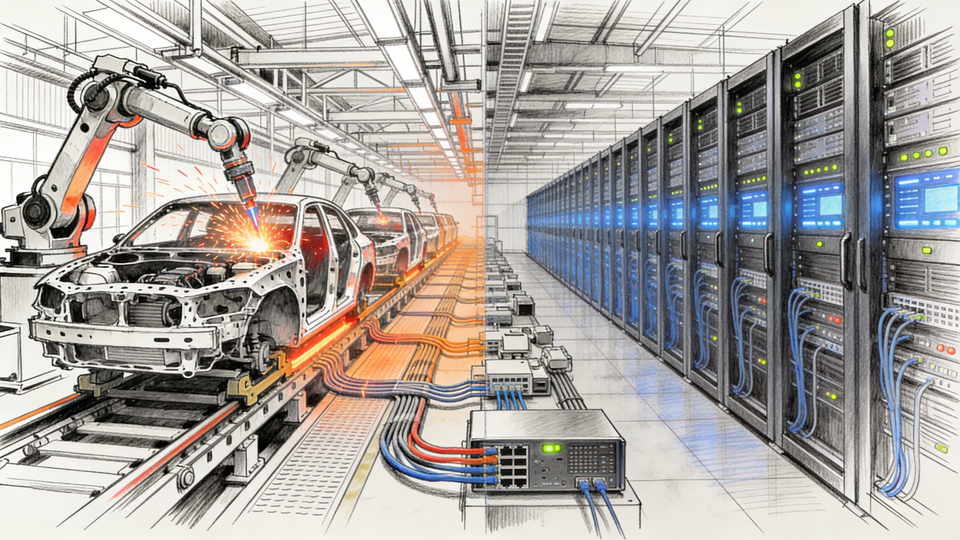
Once upon a time we built a lot of EV Factories. Now, we're building factories for AI. Something feels familiar.
The last time governments threw money at an industry that wasn't ready for it, we got gleaming factories in Ohio and Georgia sitting half-empty, waiting on buyers who hadn't shown up yet. Lordstown Motors promised an electric pickup truck and delivered a securities fraud investigation. Fisker showed up at auto shows with beautiful concept cars and exited through bankruptcy court. Nikola Corporation's founder went to prison. The whole carnival ran on a simple fuel: the terror of being left behind. Nobody wanted to miss the electric vehicle revolution, so everyone built for a revolution that arrived about a decade ahead of the market, and about three technological generations ahead of the product.
FOMO is real. This time FOMO = server farms.
The AI infrastructure boom has the same frantic energy, the same government incentives, the same suspension of disbelief about timing. Data center construction is running at a pace that assumes today's compute requirements are permanent facts of nature, like gravity or the speed of light. They aren't. They're a snapshot of where the technology happens to be right now, in this particular moment, before the engineers figure out a better way. And the engineers are already figuring out a better way.
Data center construction is running at a pace that assumes today's compute requirements are permanent facts of nature, like gravity or the speed of light.
Start with what we know about EVs. The direction was correct. Electrification is coming, and everyone who bets against it long-term is wrong. But betting on the direction and betting on pace are two different gambles. The companies and governments that poured capital into manufacturing capacity treated the adoption curve like a fixed ramp. It wasn't. Buyers came, but slowly, selectively, and with legitimate questions about whether they could charge their investment. Those questions were not based on paranoia, they were accurate concerns.
The charging infrastructure that was supposed to make EV ownership frictionless turned into a punchline. Competing standards created a fragmented landscape of various plugs, adapters, pricing, and reliability. Costs of public charging has run amuck in the face of true cost-per-mile. Ever drive an EV in cold weather? Efficiency drops dramatically for many electric models.
Because the same bet is being made right now, just with GPUs instead of charging stations. The thesis goes like this: AI requires enormous compute, Nvidia builds the hardware that delivers that compute, therefore build as many data centers as possible, fill them with Nvidia's chips, and collect the returns. States are tripping over each other to offer tax breaks and power deals and fast-track approvals. Entire regions are reshaping their grid infrastructure to attract facilities that, by the time they come online, may be solving yesterday's problem.
...build as many data centers as possible, fill them with Nvidia's chips, and collect the returns.
Nvidia is genuinely winning right now, and winning decisively. The H100, the H200, the Blackwell generation — these are real products delivering real performance. This isn't Nikola Corporation promising a truck that runs on hydrogen and delivering nothing. Yet, winning the current architecture is not the same as owning the next one. The GPU became dominant in AI because it was flexible, widely available, and already understood. That's a first-mover advantage. First-mover advantages have expiration dates, and the challengers are already in the lab.
A Toronto startup called Taalas has built a chip that embeds model parameters directly into silicon instead of executing them in software at runtime, dramatically improving performance. Like wicked fast improvement. Conventional AI accelerators waste enormous energy moving data between memory and compute during inference. Taalas etches the brains into the hardware. It runs at high speed on a fraction of the power Nvidia requires, and a customized chip fabricates in weeks, not months. That's not a tweak to the cost curve, it's a different cost curve entirely. Taalas isn't guaranteed to win, but they aren't the only ones working this problem, with the direction of the pressure becoming obvious.
Taalas has built a chip that embeds model parameters directly into silicon instead of executing them in software at runtime, dramatically improving performance. Like wicked fast improvement.
This is precisely where the EV analogy sharpens into something uncomfortable. The problem with lithium-ion battery technology was never that it didn't work. It worked fine. It works fine today. The problem was that enormous capital was committed to a manufacturing ecosystem built around one generation of chemistry, while the next generation was already in the lab. Solid-state batteries, sodium-ion cells, better thermal management are all in development while factory foundations were being poured. The automakers who went deepest on lithium-ion capacity at the exact wrong moment are now sitting on assets that need expensive retrofitting to stay relevant.
The technology moved. The concrete didn't.
The parallel for AI infrastructure is almost too clean. Billions are flowing into data centers designed around GPU clusters that require liquid cooling, massive power infrastructure, and real estate footprints that would make a suburb jealous. Taalas's architecture eliminates the need for high-bandwidth memory modules, advanced packaging, 3D stacking, and liquid cooling entirely. If that approach scales, the economic case for the hyperscale GPU cluster weakens considerably. Not collapses. Weakens. Which is enough to make a lot of very expensive infrastructure look like it was built for a problem that has since been solved more elegantly.
Taalas's architecture eliminates the need for high-bandwidth memory modules, advanced packaging, 3D stacking, and liquid cooling entirely.
Nobody is saying AI fails. Nobody is saying Nvidia collapses tomorrow. What history keeps saying, patiently, in a voice that sounds bored with having to repeat itself, is that the infrastructure built for the first generation of any technology tends to be overbuilt for it and underbuilt for what comes next. The charging network designed for CCS chargers was not designed for NACS. The factories designed for early EV volumes were not designed for the demand curve that actually materialized. The data centers being permitted, funded, and constructed right now are being designed for a compute architecture that is, at this precise moment, under serious competitive pressure from people who haven't made it onto the cover of Wired yet, or fawned over by The Verge.
The data centers being permitted, funded, and constructed right now are being designed for a compute architecture that is, at this precise moment, under serious competitive pressure from people who haven't made it onto the cover of Wired yet, or fawned over by The Verge.
The governments handing out incentives are not doing due diligence on any of this. They are doing FOMO. The venture funds piling into infrastructure plays are not modeling efficiency risk. They are modeling demand. These are not the same variable, and confusing them is the oldest mistake in the technology investment playbook.
We know how this ends because we've already watched it end. The bodies are still warm in Detroit.
Paul Salzman has spent his career at the intersection of automotive, technology, and consumer behavior, which is a polite way of saying he has seen every bad idea tried twice and funded a third time. He writes editorial commentary on an industry that confuses installing software with having a strategy. He is the founder of Wheelio, which is changing the way people seek cars.
Originally published on LinkedIn.

Comments ()