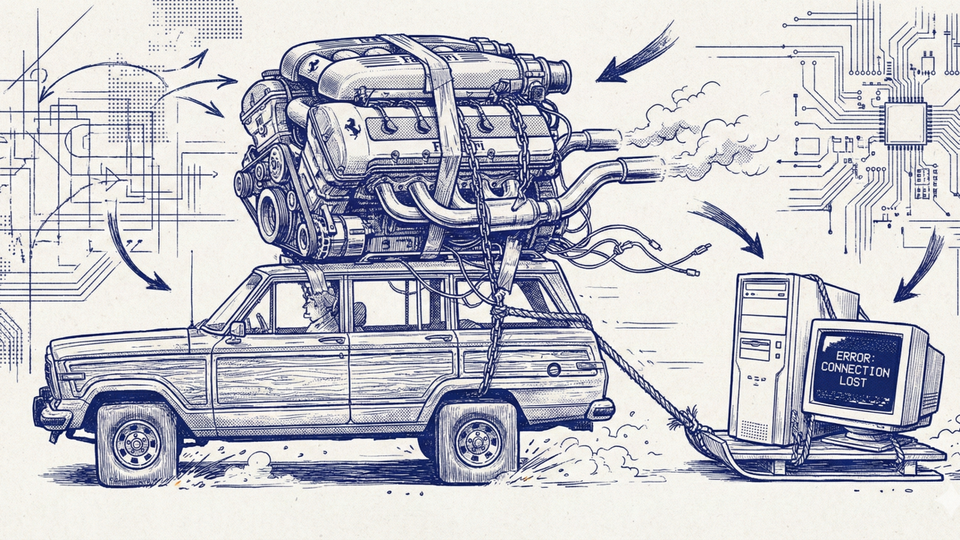
Towing Square Tires at Ferrari Speeds
Why the Automotive Dealer Tech Stack is Shaking Itself Apart
The modern dealership sits inside a digital orchestra that never rehearsed. Every screen blinks, every dashboard chirps, and every platform insists on its own magnificence. It's the kind of cacophony that would drive a lesser industry to drink. Dealers? They sip their coffee, sigh like seasoned mechanics, and sign another invoice, because in retail automotive, chaos comes standard.
For years, the industry has been bolting tools onto the tech stack like aftermarket parts on a tired Civic. First came the digital retail widgets. Then the equity miners. Then the attribution trackers. Eventually, the middleware arrived to translate languages nobody spoke in the first place.
And now, climbing down from the cloud like a Silicon Valley messiah with the emotional maturity of a toddler: Artificial Intelligence.
Let's be honest. AI didn't create the noise.
It bought the megaphone, wired it to a subwoofer, and pointed it directly at the dealer's head.
The Disconnected Jumble
The problem isn't just that the tools are loud. It's that they're strangers trapped in the same elevator, each one convinced it's the CEO.
Walk into any sales tower and look at the monitors. You'll see a CRM that doesn't acknowledge the inventory management tool. A service scheduler that treats loaner cars like invasive species. A desking tool existing in a vacuum, blissfully unaware of the "digital deal" a customer supposedly built three hours earlier.
We didn't build a tech stack.
We built the Tower of Babel, slapped single sign-on on the ruins, and called it progress.
And the bill for this multilingual clown show would make a CFO reach for the Tums. Stores now spend more on digital tools and subscriptions than at any point in recorded history, yet the ROI limps along like a mule with a slipped disc.
We didn't buy efficiency. We bought fragmentation with a 12-month contract and a cheerful onboarding rep.
The Newest Guest at the Bad Party
Into this fractured landscape strolls AI -- marketed as the glue that would finally make the machine purr. Instead, it became another layer of sagging drywall slouching over a crooked frame.
Vendors bolted "AI-powered" onto their websites like a fake hood scoop held on with 3M tape. Chatbots became "virtual agents." Price sliders became "predictive engines." Anything with an if/then statement became "machine learning."
And because these AI toys are glued onto legacy systems that barely speak to each other, the "intelligence" is trapped in silos, spinning like a hamster convinced it's powering the Eastern Seaboard.
The result?
A chatbot that confidently tells customers the service drive is open on Christmas Day -- while the CRM sits in the corner, blissfully unaware a conversation even happened.
Dealers were promised automation. What they got was software that needs a chaperone.
Someone has to verify the AI's math. Someone has to manually paste data into the DMS because the API union staged another walkout. Someone has to apologize when three automated systems fire off three contradictory emails in the span of ten minutes; like a misfiring ignition coil trying to explain itself.
These tools promise clarity.
They deliver confetti.
The Failure of Mechanical Sympathy
If cars were built the way dealership software is built, the transmission would refuse to speak to the driveshaft, and the brakes would require a subscription to engage.
Engineering respects the relationships between components.
Dealership software respects the relationships between vendors.
There's a term in the automotive world: mechanical sympathy -- the idea that machinery works best when every part understands the others' purpose. Dealer retail tech has none. It's a patchwork quilt of disjointed features stitched together with marketing slogans.
Dealers now pay for a dozen subscriptions that behave like rival fiefdoms. The spend is enormous. The disruption is relentless. And AI simply bolts horsepower onto a wagon with square wheels.
A Ferrari engine cannot cure a geometry problem, but it will ensure you arrive at the accident with impressive speed.
The Reckoning
Eventually -- always -- the reckoning arrives. Not with fireworks, but with a quiet, terrifying question from the Dealer Principal staring at the monthly P&L:
"Why am I paying this much to be this confused?"
How long can dealers pay luxury prices for tools that behave like they were built during a hackathon fueled by cheap pizza, warm Mountain Dew, and no adult supervision?
How long can they tolerate a "tech stack" that looks less like a stack and more like a pile?
How long before AI's grand promises require their own dedicated babysitter?
This industry does not need another feature. It does not need another widget chirping from the corner, or an "AI engagement optimizer" promising enlightenment.
It needs a clean slate.
It needs fewer tools, stronger tools, quieter tools -- systems where data flows like electricity instead of dripping like molasses. It needs the conviction to sweep away the noise and get back to the mechanics of the sale.
Because until the foundation is rebuilt, adding AI is nothing but turning up the volume on a song nobody liked in the first place. And the industry knows it. It's just waiting for someone brave enough, or fed up enough, to hit stop.
Paul Salzman dissects the machinery of modern industry, tracing the ambition that drives it, the compromises that rust it, and the warning noises no one hears until the whole system finally gives out.
Originally published on LinkedIn.

Comments ()